Feedback Testers vs. Oscilloscopes: Which Is Right for my Servo/Encoder?
When troubleshooting a servo motor or encoder problem, maintenance and repair technicians might find themselves wondering: Do I need a feedback tester or an oscilloscope?
The short answer is that it depends on what problem you’re trying to solve. While oscilloscopes are excellent electronic diagnostic tools, dedicated feedback testers like the Mitchell Electronics, Inc. TI-5000JX are built specifically to test, diagnose, align, read, and program servo feedback devices such as encoders and resolvers.
Let’s examine both tools, understand where each excels, and why manufacturers and servo motor repair centers often choose to use them together.
Feedback Testers vs. Oscilloscopes: Where Each Excels
When to Use an Oscilloscope
An oscilloscope is ideal for viewing stator waveforms and feedback analog signals.
Key Benefits Include:
- Displays analog and digital waveforms for signal integrity analysis.
- Measures voltage, frequency, noise, and timing characteristics.
- Allows viewing Hall effect amplitude and signal waveforms, and checking time domain characteristics on serial signals.
- Recommended for checking back-drive EMF (electromotive force) to diagnose motor magnet strength and three-phase voltage patterns.
- Can offer extremely high bandwidth performance.
Best Applications Include:
- Noise on signal lines
- Diagnosing drive output irregularities
- Power quality issues affecting servo systems
Essential Prerequisites for Effective Diagnosis
While the oscilloscope is a powerful diagnostic tool, its effectiveness depends heavily on the operator’s expertise and adherence to proper procedures. It is not a substitute for specialized knowledge and can take some time to set up. Essential prerequisites for effective oscilloscope use include:
- Instrument Configuration: Mastery of scope setup, including triggering, time-base, and voltage-scale settings, to accurately capture transient or complex waveforms.
- Signal Integrity and Sampling: A clear understanding of the Nyquist-Shannon sampling theorem to prevent aliasing, which can lead to misinterpretation of signal frequency and form.
- Grounding and Probing: Proper management of grounding loops and adherence to correct probing techniques to ensure accurate measurements and mitigate potential safety risks or signal distortion from loading effects.
The bottom line is, if you want to see the signal characteristics, use an oscilloscope.
When to Use a Feedback Tester
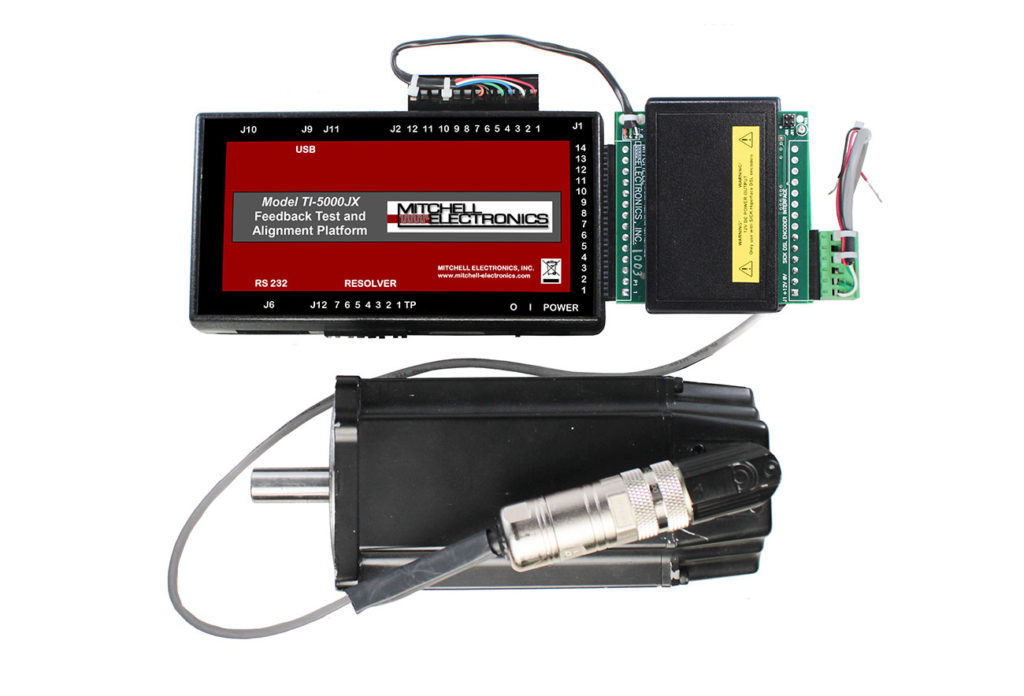 Feedback testers are designed specifically for servo motor feedback devices. They support the testing of incremental encoders, absolute encoders, serial encoders, and resolvers across many major brands.
Key Benefits:
- Quickly tests encoder and resolver functionality
- Measures signal voltages for quadrature pulse and resolver feedback sensors
- Reads memory parameters in supported serial encoders
- Confirms counts per revolution – catches the Z pulse or summarizes serial counts and serial revolutions
- Verifies alignment/commutation offset values
- Supports multiple brands using standardized procedures
- Verify after repairs
- Reads and interprets encoder memory parameters (such as Motor Type, Nominal Torque, and Max Velocity) in a human-readable format, supporting data integrity checks and checksum verification.
- Displays encoder count, electrical angle, and mechanical angle to provide adjustment tolerance for precision alignment across various motor pole counts.
- Provides support for a variety of complex serial encoder protocols, including BiSS, EnDat (2.1 and 2.2), Hiperface DSL, Fanuc, Mitsubishi, Indramat, and many others.
Best Applications Include:
- Servo motor repair centers
- Manufacturers with recurring downtime issues
- Encoder replacement and reinstallation
- Alignment verification after teardown, using precise electrical and mechanical angle data.
- Fast pass/fail diagnostics
- Reading, writing, and saving encoder memory data to correct corruption.
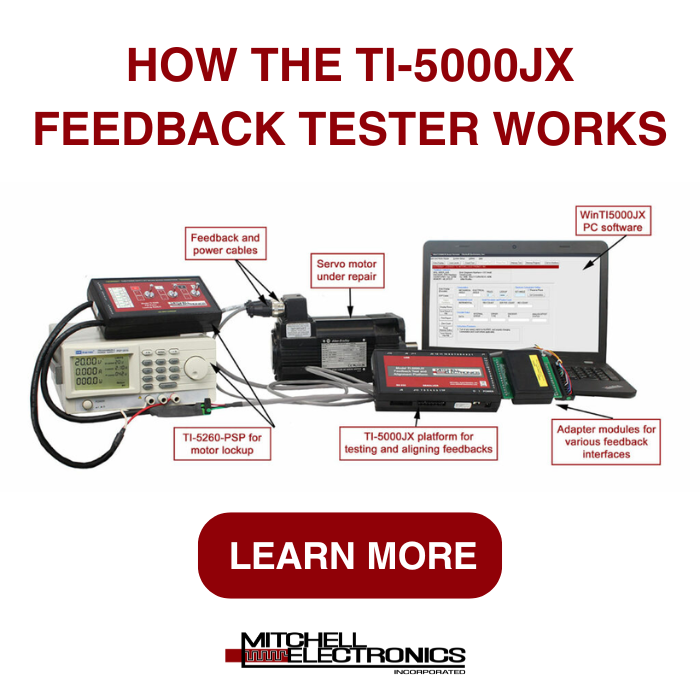
If you need to know whether the feedback device works correctly, use a dedicated Mitchell Electronics, Inc. tester.
Using These Tools Together
Often, it’s not a question of choosing one tool over the other. Together, they help you:
- Fully troubleshoot servo motor systems
- Diagnose both electrical and mechanical feedback issues
- Reduce downtime faster
- Validate repairs before reinstalling equipment
- Strengthen a predictive maintenance program
For example, an encoder may produce a clean square wave on an oscilloscope yet still contain incorrect stored parameters, wrong counts-per-turn data, or alignment errors that cause servo faults. Conversely, a feedback tester may verify encoder configuration while an oscilloscope exposes electrical noise.
That’s why each tool has a distinct role:
- Feedback tester: device-specific diagnostics, alignment, and configuration
- Oscilloscope: waveform capture and signal-level analysis
The Value of Specialized Instrumentation
Today, hybrid devices are available that consolidate multiple diagnostic functions for convenience. While the appeal of an all-in-one solution is understandable, it is essential to recognize that optimal results in complex servo and encoder diagnosis are typically achieved by utilizing dedicated, best-in-class tools, such as a specialized feedback tester alongside a high-performance oscilloscope.
Tools promoting the ability to do everything, while seemingly efficient, often necessitate a compromise on performance across all integrated functions. Consider the utility of a popular multi-function knife: it provides a range of basic functions but is not intended to replace the precision and capability of a full set of specialized tools used by a professional.
The critical insight here is that purpose-built instruments, engineered to excel at specific diagnostic tasks, consistently deliver more reliable and precise results than alternatives designed to cover a wide, general spectrum of applications. The synergy of specialized tools ensures comprehensive and accurate system analysis.
The Bottom Line
Oscilloscopes and specialized feedback testers are indispensable assets for professional servo motor repair teams. While the appeal to overgeneralize or oversimplify a problem with a single solution is understandable, expert technicians cannot afford to compromise precision and capability.
The industry places a high value on professionals skilled in utilizing both dedicated instruments: specialized feedback diagnostic and run-test products, and oscilloscopes for comprehensive waveform and signal integrity analysis. This dual competency ensures a thorough, accurate, and efficient path to achieving and validating reliable machine performance.