



Servo Encoder Testing, Maintenance, and Alignment
Encoders are one of the most important components in a servo motor application, enabling a control system to function properly.
This page provides the essentials of how encoders convert motion into actionable electrical signals, how they integrate into the servo feedback loop, and why different encoder types (from incremental to absolute and serial) are suited to different applications.
Jump to Section:
- What Are Servo Encoders and How Do They Work?
- The 5 Types of Servo Encoders
- How to Tell When Your Encoder Needs Maintenance
- How to Test a Servo Motor Encoder
- Encoder Alignment Made Simple
- Essential Servo Motor Encoder Testing Tools
What Are Servo Encoders and How Do They Work?
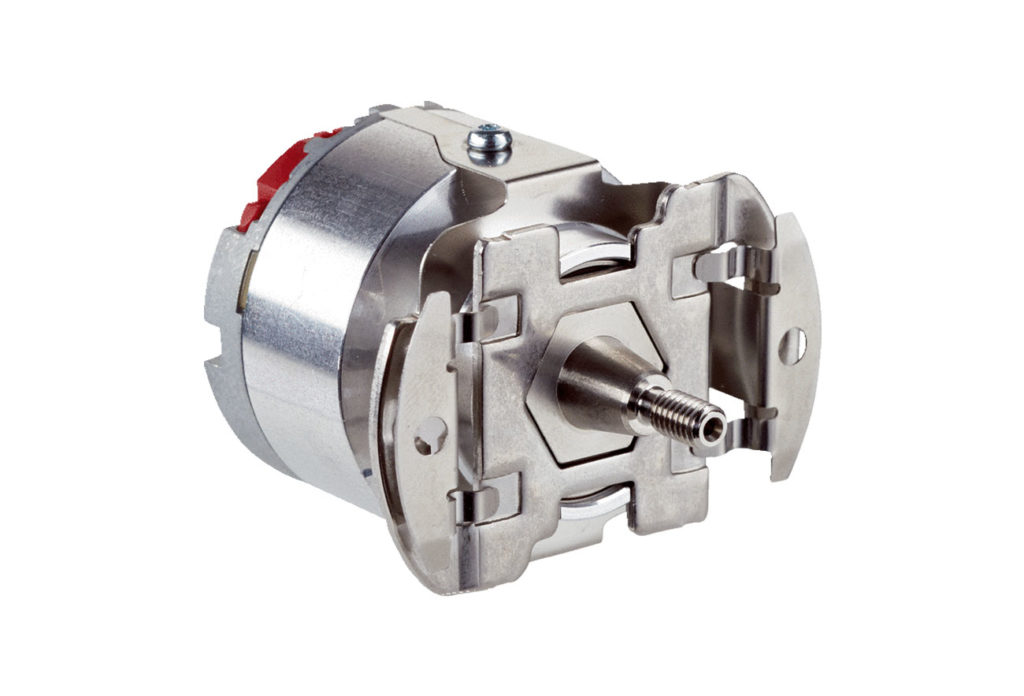 In a servo system, the encoder is mounted on the motor shaft and tightly integrated into the feedback loop. As the motor spins, the encoder tracks the shaft’s position and sends this data to the motor controller, which then compares the actual position to the desired one.
This loop enables micro-adjustments to speed, torque, and positioning, which are essential in high-performance applications like CNC machines, robotics, and semiconductor manufacturing. Without the encoder’s continuous stream of data, the controller would be “flying blind,” unable to correct for overshoot, undershoot, or positional drift.
Modern servo systems often use high-resolution digital encoders, allowing thousands, or even millions, of counts per revolution. This granularity is key for applications demanding submillimeter precision.
Encoders are one of the most important components in a servo motor application, enabling a control system to function properly. We are familiar with many control systems, such as how bicyclists use their eyes to adjust their speed or direction, and musicians use their ears to adjust their volume and pitch.
Encoders sense the position of the motor, allowing a servo drive to commutate the motor. A servo controller can also use this position to calculate speed and control motor torque for use in high-precision automated industrial applications.
At its core, an encoder reads motion, either linear or rotary, and converts it into a digital or analog signal that a control system can interpret. In servo motor systems, the encoder reports the motor shaft’s position back to the controller, enabling real-time corrections to ensure the motor performs exactly as commanded.
For example, in a robotic arm, there may be several servo motors controlling several axes of movement or rotation. Each of these servo motors would have an encoder providing position and speed information to the controller. With this information, the controller could determine that a joint has moved 45 degrees, for example, allowing the system to confirm that the motion corresponds to the input command. If not, the controller adjusts the voltage or current to correct the discrepancy. This feedback loop is what makes servo motors “intelligent” and highly accurate.
A typical servo motor encoder consists of three primary components:
1. Code Disc
The encoder’s code disc is attached to the motor shaft and has patterns of lines or slots. In optical encoders, this disc is transparent with opaque lines, while in magnetic encoders, it contains magnetic poles.
2. Sensor
As the disc rotates, an optical or magnetic sensor detects these patterns, generating pulses or signals corresponding to the shaft’s position. There are two types of sensors: optical and magnetic. Optical sensors use light to detect changes, while magnetic sensors use magnetic fields.
3. Signal Processor
The encoder’s sensor collects this data and converts it into a digital signal that is sent to the controller – either as serial data or incremental line states. The controller uses this information to make needed adjustments to the equipment’s speed or position.
The 5 Types of Servo Encoders
Encoders come in several forms, each suited to specific applications:
- Incremental Encoders
- Absolute Encoders
- Serial Encoders
- Resolver-Based Encoders
- Sine-Cosine Encoders
Incremental Encoders
Incremental Encoders produce a series of pulses as the shaft rotates. The controller counts these pulses to track movement. While simple and cost-effective, incremental encoders do not provide absolute position data on power-up, and therefore require indexing, which means turning the encoder until it passes through the zero position.
The most common type of incremental encoder uses an AB Quadrature style of encoding. A Z pulse is often included to indicate the zero position. When the Z pulse is not included, then the encoder is usually not used in a position servo function but rather in a speed function as a type of tachometer.
Absolute Encoders
Absolute Encoders provide a unique position value for each shaft angle. Many types use either binary or gray code. This means the system knows the exact position immediately upon startup, but may require a cable with many wires to carry all the bits.
Serial Encoders
Serial Encoders provide position data using a communications protocol. A serial encoder may operate with only two wires for communications: transmit and receive. The receive wire may be used to send commands to the encoder to receive position or other parameters, and the response is sent back to the drive or controller on the transmit line. The position information is often absolute but does not have to be. Therefore, one must be careful with nomenclature
Resolver-Based Encoders and Sine-Cosine Encoders
Resolver-Based Encoders and Sine-Cosine Encoders are also used in harsh environments or high-precision applications. They generate analog signals that are interpreted for precise angular feedback.
How to Tell When Your Encoder Needs Maintenance
Issues with servo motor encoders can lead to inaccurate positioning, system errors, or motor failure. All of which have a detrimental effect on product quality, production, and profitability.
The best course of action is to address issues as soon as possible. Here are 6 warning signs that a servo motor encoder may need to be serviced:
1. Physical Wear
The accumulation of dust, oil, or damage to the encoder housing or connections is a common issue and will lead to underperformance or malfunctions.
2. Inconsistent Positioning
If the motor is unable to reach the programmed position accurately, or if there are fluctuations during operation, this could be a sign of encoder malfunction.
3. Erratic or Noisy Movement
Unpredictable or jerky movements often indicate an issue with the feedback signal from the encoder.
4. Drift or Offset in Position
Over time, the encoder may produce inaccurate position data, causing the motor to move incorrectly or deviate from its intended path.
5. Loss of Feedback Signal
If the motor suddenly stops or behaves unexpectedly, it may be due to a sporadic or complete loss of the encoder feedback signal.
6. Error Codes

Many newer encoders often have internal diagnostics that will generate error codes or alarms when the encoder is not functioning properly.
A simple encoder failure can cause damage to other parts of your machine. It can also generate financial losses due to the production of non-conforming material that must be scrapped after the manufacturing problem is detected.
Detecting encoder issues early can prevent further damage and costly repairs. Before jumping into repairs, take the time to visually inspect and test the servo motor. This can validate and pinpoint the problem area(s) and speed repair time.
Regular maintenance and proper installation can help mitigate these issues. Still, even the most well-maintained encoders can experience problems. Following these steps can help you maintain encoder integrity when servicing a servo motor.
How to Test a Servo Motor Encoder
Testing a servo motor encoder involves several steps. Begin by visually inspecting the encoder and wiring for any loose connections or damage. A few minutes here could save significant repair time and costs.
If everything seems to be intact, continue by ensuring that the motor and encoder are securely mounted to a stable platform. This will help to prevent movement during testing. Also, make sure the power supply to the motor is off. This will help to avoid accidental activation.
Once the motor is secure, follow these basic steps:
1. Monitor Output Signals
Connect the encoder to a test device or oscilloscope to monitor the output signals. Slowly rotate the servo motor shaft by hand, carefully observing the output. For incremental encoders, check for a consistent pattern of pulses as the shaft rotates. Each pulse corresponds to a specific angular movement of the motor shaft. For absolute encoders, ensure that the output signal changes appropriately according to the shaft’s position. You may need a test device that can interpret serial data and display a position count.
2. Test the Encoder
Slowly rotate the motor shaft manually and observe the generated pulses; these should be consistent and evenly spaced for incremental encoders. For absolute encoders, verify that each position generates a unique code. You can also test the encoder by integrating it with the motor control system and checking the feedback response. Any irregularities, such as missed pulses or incorrect positioning, may indicate a fault in the encoder.
3. Measure the Voltage
If using an oscilloscope, you should see a series of square waves representing the encoder’s output as the shaft rotates. With an oscilloscope or multimeter, you’ll measure voltage levels and changes as the encoder’s signals switch states.
Risks of Manually Testing a Servo Motor Encoder
Manually testing a servo motor encoder carries some risk, as improper handling can damage the encoder or motor, especially if excessive force is applied when removing it from a motor or if the components are not handled with proper ESD precautions. There is also a risk of short circuits if the wiring is not correctly handled. You must observe allowable power supply voltage ranges when powering up your encoder to manually test it.
Additionally, if the motor unexpectedly powers up during the test, it can cause injury or damage to the testing equipment. For these and other reasons, proper safety precautions, such as using insulated tools and ensuring the motor is disconnected from its power source, are essential.
Feedback Testers vs. Oscilloscopes: Which Is Right for My Servo/Encoder?
Encoder Alignment Made Simple
 The encoder alignment angle is the relationship between the encoder and the motor windings. This association is extremely important.
Encoders must be aligned with sufficient accuracy so that the motor can be correctly commutated by the drive and can provide the torque and velocity that are commanded by the controller for the application. Even slight alignment variations can cause the motor to run poorly or not at all.
How to Tell if an Encoder is Properly Aligned
Servo motor alignment should be checked whenever a motor is suspected to be defective. Symptoms of misalignment include overheating, overcurrent, motor vibration, and so on. Because these issues can be traced to many areas, alignment issues are easily misdiagnosed as a winding, magnet, or bearing problem.
While there are many ways that a servo can become misaligned, a leading culprit is human error. Encoders are routinely removed from the servo motor for nearly any type of maintenance or repair. And this opens the door to potential problems, as servos sometimes return from repair misaligned. Because of this, they should be closely examined and tested before returning to service.
Essential Servo Motor Encoder Testing Tools
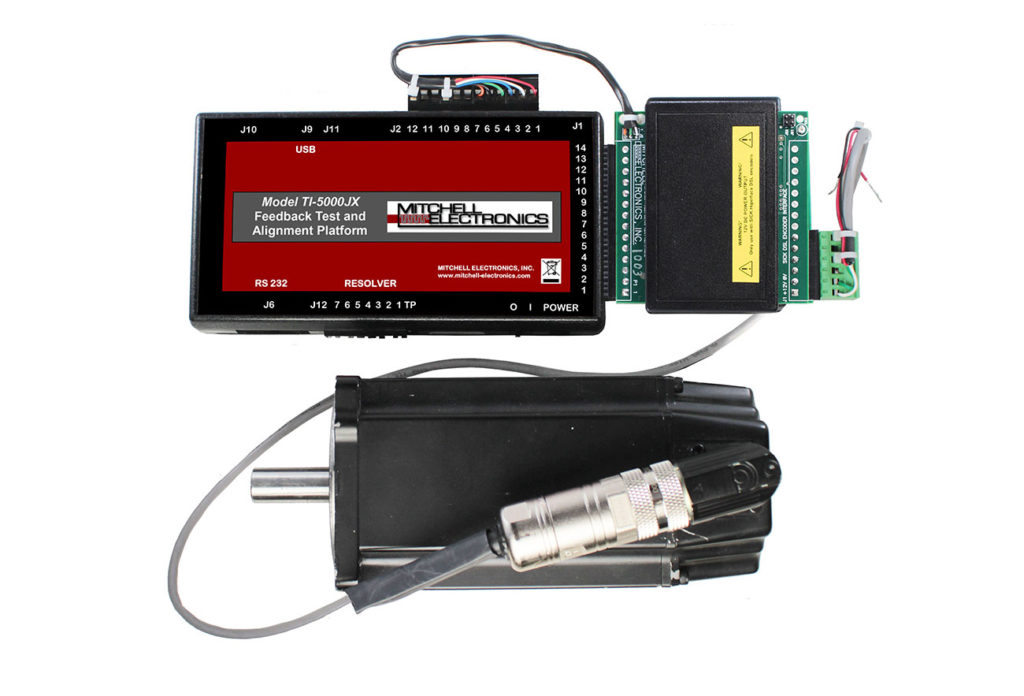 At Mitchell Electronics, Inc., we offer a range of products and services designed to maintain the integrity of servo motor encoders and ensure reliable performance. Repair centers and manufacturers alike turn to us for the industry’s most trusted encoder testing products.
The TI-5000JX is a servo motor feedback tester product that is used to test the encoder or resolver that is used on a permanent magnet brushless AC or DC servo motor. Servo motor testing and troubleshooting requires the confirmation of certain key parameters.
The TI-3000JX is a run-test product that acts as a universal servo motor drive, providing a diagnostic test before or after a servo motor repair. Manufacturer-specific servo motor drives can be excellent for verifying servo motors but can be difficult and time-consuming to configure. It is also not always practical to have a spare servo motor drive for every servo motor that you wish to run.
In addition to our proven tools, we offer expert assistance and training to help your staff to ensure proper encoder alignment.
You can also download The Quick Reference Guide to Servo Motor Maintenance and Repair. Inside this in-depth guide, you’ll find insights into:
- Diagnosing common servo issues
- Understanding typical servo error codes
- Knowing what you can fix in-house and what needs to be sent out for repair
- Identifying tools you’ll need to make repairs in-house
