



When Should Repair Shops Offer Servo Motor Repair Services?
For many motor repair centers, outsourcing servo motor testing has been a practical choice. It allows shops to handle servo repairs without investing in specialized equipment or additional resources. And for some, it still makes good business sense.
But things are changing. Customers expect faster turnaround and increasingly want complete service from a single provider. At the same time, today’s servo motor testing systems are easier to use, more capable, and more affordable than ever.
So, is outsourcing still the best approach for your business? If you’re seeing more servo motors come through the door, or want to grow that part of your business, here are 5 reasons why you should bring servo motor testing in-house.
1. You Have the Servo Repair Volume to Justify In-House Repair
 Above all, bringing testing in-house has to make business sense. If servo motors only come through your shop occasionally, outsourcing may still be the most practical option. But the equation changes as servo repair volume increases. If you’re sending motors or feedback devices out for testing every week, the cumulative cost, time, and inconvenience of outsourcing can become significant.
Take a look at how many servo repairs you’ve handled over the past year. How much testing did you outsource? Is that number growing? And how much additional servo work could you handle if you had the ability to test in-house? The question isn’t whether you have enough servo business today. It’s whether bringing testing in-house could help you handle more of it tomorrow.
2. Outsourcing Servo Repair Could Be Limiting Your Profitability
The invoice from your testing provider is only part of the equation. Every outsourced test can bring additional costs that are easy to overlook. Shipping, administrative time, scheduling coordination, additional handling, and the productivity lost while a repair waits for results all contribute to the true cost of outsourcing.
There can also be opportunity costs. A motor sitting in your shop waiting for outside test results isn’t being completed, invoiced, or returned to the customer. And technicians may be unable to move forward with a repair until they have the information they need.
Individually, these costs may not seem significant. But over dozens or hundreds of repairs, they can add up quickly. When evaluating in-house testing, compare the investment against the total cost of outsourcing, not simply the price on your testing provider’s invoice.
3. Bringing Servo Motor Repair in-House Will Reduce Turnaround Time
For many customers, turnaround time matters just as much as repair cost. Every time a servo motor or feedback device leaves your facility for testing, your schedule becomes dependent on shipping, another company’s workload, and priorities you can’t control. Even when your testing partner provides excellent service, those extra steps add time to the process.
In-house testing reduces waiting. Technicians can test components when they need to, use the results to guide the repair, retest as necessary, and perform final verification without sending equipment back and forth. That can mean shorter repair cycles, greater scheduling flexibility, and a more predictable delivery date for your customer. It also gives your shop greater control when a customer has an emergency and needs a motor back in service as quickly as possible. In a business where downtime can be extremely expensive, responsiveness can be a powerful competitive advantage.

4. Servo Motor Testing Equipment is Affordable, Flexible, and Easy to Use
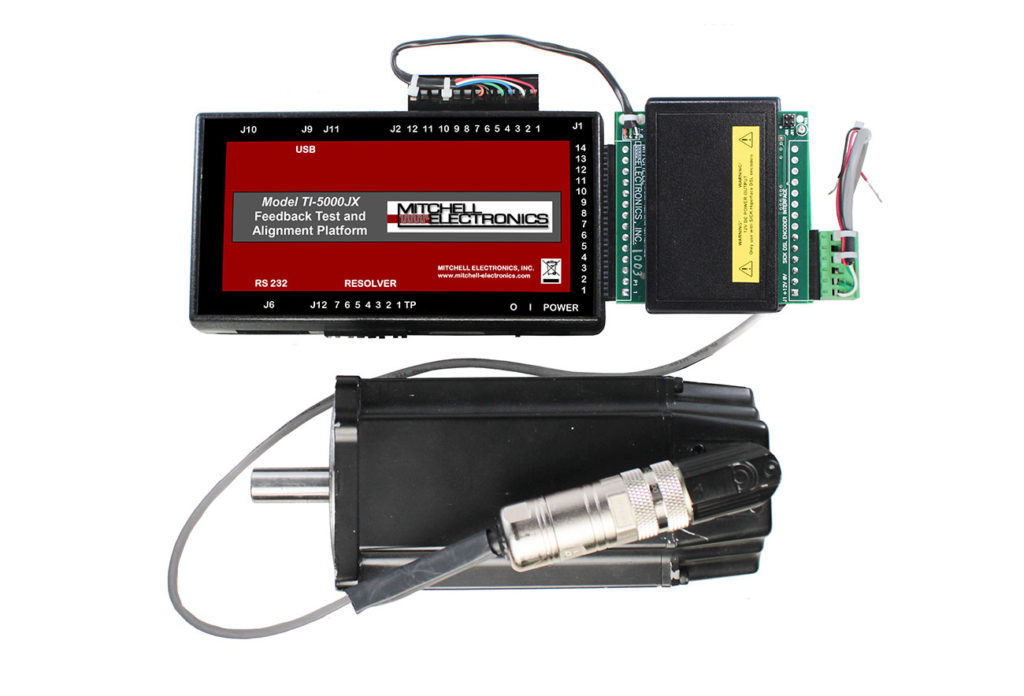 Bringing servo motor testing in-house requires more than simply purchasing a piece of test equipment. The good news is that the requirements may be more manageable than you think.
Start with your people. In the past, diagnosing servo feedback devices often meant using general-purpose equipment such as an oscilloscope and relying heavily on technician experience to interpret waveforms. Today’s dedicated servo motor diagnostic systems can simplify that process by guiding technicians through established procedures and providing repeatable, documented results. And some systems can read a variety of serial protocols. (For more on this, read our blog: Advantages of a Servo Motor Tester that can Read Multiple Serial Protocols.) That can allow less-experienced technicians to perform more of the testing while making experienced technicians more productive.
But people and equipment are only part of the equation. A successful in-house operation also requires the right environment and processes. Consider whether you have a clean, dedicated workspace; appropriate diagnostic and repair tools; trained personnel; standardized procedures; proper documentation; safety practices; and access to the parts and resources technicians need to do the job consistently. In many cases, repair centers may already have much of the infrastructure in place. The key is identifying what’s missing and developing a plan to fill those gaps.
For a more detailed look at what an effective in-house operation requires, read our blog: 7 Requirements for an In-House Servo Motor Repair Environment.
5. Bringing Servo Motor Repair In-House Allows You to Control Quality
At the end of the day, your shop is the one guaranteeing the quality of the repair. But if you don’t have the ability to test and verify the motor yourself, you’re relying on someone else’s work without a way to confirm the results.
If an outside repair partner is delivering poor-quality work, you want to catch it before the motor goes back to your customer, not after it fails on the production floor. Even if you have complete confidence in your supplier, verification still matters. An in-house test process gives you a consistent and reliable way to validate the repair, document performance, and know that every motor leaving your facility meets your standards.
Making the Decision
Bringing servo motor testing in-house isn’t the right choice for every repair center. If servo motors only occasionally come through the door, outsourcing may continue to be the most practical and economical solution. Additionally, outsourcing can be a good option to help with unusually large spikes in demand or specialized work.
But if servo repairs are becoming a regular part of your business, or you want them to become one, the calculation changes:
- Look at your repair volume
- Calculate the complete cost of outsourcing
- Consider how much time outside testing adds to each repair
- Determine whether today’s testing technology can enable your existing technicians to perform more of the work
- And perhaps most importantly, consider the business you could pursue if testing were no longer a limitation.
For decades, Mitchell Electronics, Inc. has helped motor repair centers develop the capabilities needed to test servo motors and feedback devices in-house. Whether you’re just beginning to evaluate the opportunity or are ready to expand your servo repair capabilities, answering these five questions can help determine whether bringing testing in-house makes sense for your business.